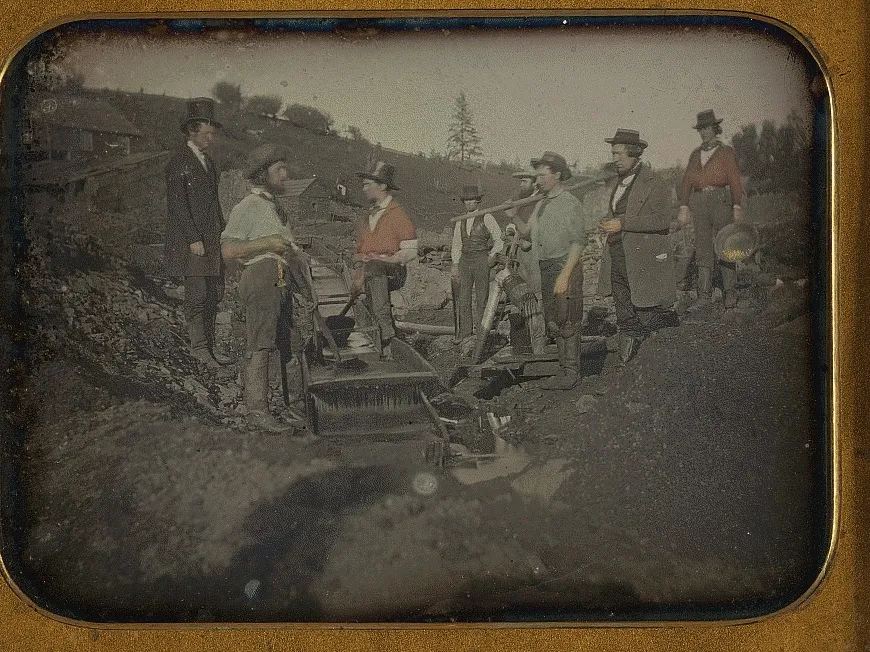
The people who made money most reliably in the gold rush, the story goes, weren’t the miners who dug for gold but the merchants who sold the picks, the shovels, and the cloth. Levi Strauss himself was a dry-goods seller in San Francisco back then. Gold or no gold, everyone who showed up to dig still had to buy the gear.
Out of this came a mental tool: the pick-and-shovel play. Don’t bet on the stars of the frenzy directly; stand instead with the side that owns the tools they’re all forced to buy. You don’t have to call the winner to win.
Hold the analogy up to AI today and it fits almost perfectly. Nobody knows who’ll build the best AI, but every one of them buys Nvidia’s chips. Climb one rung and there’s TSMC, the company that actually fabricates those chips. Step one space over and there’s Samsung and SK Hynix, holding the high-bandwidth memory (HBM) that every chip has to carry. The shovel seller, the forge that hammers out the shovels, the steel set into the blade. A tollgate at every chokepoint. It fits. And that’s exactly what makes it dangerous.
The better an analogy fits, the less we bother to push it all the way through. Let’s take it one step further.
First crack: when shovels sell best
The reassurance that “you win even if you can’t call the winner” usually comes paired with “and besides, it looks cheap.” But in the shovel seller’s world, looking cheap is the trap itself.
Shovels sell hardest when the gold fever peaks, and that’s when the merchant’s coffers are fullest. Judged by earnings, that exact moment is when the shop looks cheapest. But that fullness is precisely the signal that the fever has hit its ceiling.
The live example is SK Hynix. Its stock has risen roughly ninefold over the past two years, yet its forward P/E — price against next year’s expected earnings — still sits around six. The stock didn’t get expensive; earnings just swelled that much. On the surface it reads as “up ninefold and still dirt cheap.” But in a cyclical industry like memory, earnings explode at the peak and shrivel at the bottom. Since P/E is price divided by earnings, inflated earnings at the peak make it look low, while at the trough, when earnings dry up, it spikes the other way — or the company slips into a loss altogether. So a low P/E can be a peak warning rather than an all-clear. The moment shovels look like they’re selling best is, in fact, the moment you’re paying the most.
Second crack: when the mine runs dry, the shovel seller is finished too
Take Cisco. In the late 1990s it was called the pick-and-shovel play of the internet: while everyone rushed to mine the gold that was the internet, Cisco sold the networking gear laid down along the way. In 2000 it became the most valuable company in the world. Then the bubble burst, roughly 90% of its market cap evaporated, and it took 25 years for the stock to reclaim that high. Its market cap still falls short of the peak it hit back then.
The company didn’t go under. Cisco is still running just fine today. The ones who went under were the people who bought at the top. A good company and a good decision turned out to be two different things.
So the next question narrows to one. Is there really gold in that mine right now? AI’s demand for shovels ultimately flows from the money the giant companies are pouring in. And right now, what they spend on AI data centers runs far ahead of the revenue they actually earn from AI. Spending can’t outrun earning for this long. The moment any of them decides the money won’t come back, the shovel orders are the first thing to stop. That’s exactly what happened to Cisco.
Does that shovel work in other mines too?
Even among shovel sellers, whether there’s one mine or many is what separates survival from death. Nvidia’s chips survived by hopping mines — from gaming to crypto, then to AI, and now to robotics. A general-purpose shovel. The more a tool is built for AI alone, by contrast, the more its fate is chained to a single mine. The claim that “the pick-and-shovel play is safe” turns out to carry a long footnote: only while the mine is alive, and only when the shovel is general-purpose.
This isn’t really a story about companies. It’s a story about how far you can trust an analogy. An analogy is a ladder. It carries you up fast to a certain height, but past that you have to climb on your own. “The pick-and-shovel play is safe” was a middle rung, not the top. The better an analogy fits, the more it’s worth doubting once more — because fitting well just means you’ve already been talked into it.
— tomte
Read next · Jensen Huang’s ‘$0 Market’ Strategy: How to Arrive Before the Market Does