A medieval guild master never wrote his secrets down. How thin to pare the leather, how long to heat the iron until it turned the right color — none of that lived in a book. It lived in his hands and his head. He passed it to an apprentice directly, by hand, over years. Keeping the craft unwritten wasn’t laziness; it was power. Knowledge that existed only in his head was exactly what made him impossible to replace.
The philosopher Michael Polanyi gave this phenomenon a name. “We can know more than we can tell.” Just as you can’t fully explain how to ride a bicycle in words, most of what we know stays submerged in the body and in intuition, never quite making it into language. This is what he called tacit knowledge. The knowledge inside an organization works the same way. It lives overwhelmingly in people’s heads, not in the archive.
The first piece in this series looked at what a single source of truth (SSOT) does for an agent: that it’s a trustworthy address to stand on, and the floor of grounding that keeps the agent from making answers up. But a question followed naturally from that. Who pays to build and maintain that unshakable reference, and how much? The price turns out to be steeper than it looks — because building a single source of truth means finally paying down a debt we’ve been deferring into people’s heads all along.
The economics of delegation
For a long time, organizations simply left this tacit knowledge in people’s heads. And that was a perfectly reasonable choice.
Leaving it in the head costs nothing to externalize. When you need it, you just ask the person. Manager Kim could say “you just know that by feel,” and that was enough; you didn’t have to sit in the meeting if you already knew “he’ll react like this.” It was cheap, fast, and flexible. In effect, the organization had delegated its knowledge to people — to a storage vault with an externalization cost of zero.
This arrangement worked under one condition: the person pulling the knowledge out was also a person. People ask again when something’s unclear, fill in the missing context as they listen, and interpret reasonably on their own. Even half-formed knowledge in someone’s head transferred well enough from one person to the next. So there was never much reason to spell everything out, neatly, in writing.
But an agent can’t ask Manager Kim. For an agent to do anything, the knowledge has to be written down in actual words. What lives only in someone’s head may as well not exist, as far as the agent is concerned. And suddenly an invoice arrives for what used to cost nothing. That’s why everyone is now scrambling to drag what was in their heads out into documents.
It was a deferred debt all along
But was the knowledge we kept in our heads really free? No. It was a deferred debt.
Software has a term for this: technical debt. Cut a corner because you’re in a hurry and you move fast now, but it comes back later with interest. Knowledge in the head behaves the same way. It’s a kind of knowledge debt. The moment the person quits, takes a vacation, or simply forgets, the knowledge evaporates wholesale. The risk that a project stalls when a single key person disappears even has a name — the bus factor. It’s the grim joke that if that one person gets hit by a bus, it’s over.
So what’s happening now isn’t a new cost appearing out of nowhere. It’s closer to a debt that always had to be paid, with the age of agents simply calling it in early. Back when only people did the work, you could keep deferring the interest by saying “just ask Manager Kim.” As the chart shows, knowledge kept only in the head looks flat and free for a while, but the debt quietly accumulates and then comes due all at once — a cliff — the moment the person walks out the door. The side that writes things down in advance pays a little upfront and stays stable from there.
The public-good trap
If that’s the case, everyone should just diligently write things down — so why doesn’t that happen? Because a single source of truth is a textbook public good.
A public good is an asset anyone can take and use for free, one that doesn’t wear out when one more person uses it. A well-built single source of truth is exactly that. The catch is that making it takes effort. And here a nasty asymmetry sets in. The cost is private and immediate (I spend my time writing it), while the benefit is public and arrives much later (someday others will profit from it). Structures like this are always underprovided. The cause has a name economists use: free-riding. Everyone puts it off thinking “someone else will write it,” and in the end nobody does.
Inside an organization, this asymmetry shows up as rational resistance — not a vague aversion to change, but refusal with reasons behind it. First, scarcity was power. “Only I know this” was a person’s value and their security, and being told to write down everything they know is a demand to voluntarily shrink their own irreplaceability. Second, the one paying the cost and the one reaping the benefit are different people. The tedious work of writing it up falls to the senior who holds the knowledge, while the gains — faster onboarding, automation — go to the organization and the juniors. When effort and reward come apart like that, motivation never materializes. Third, as Polanyi said, tacit knowledge can’t be fully put into words in the first place. There’s genuine truth in the craftsman’s protest that “if I write it down, half of it disappears.”
That’s why attempts to externalize everything mostly fail. The point isn’t “all of it” — it’s selecting only what the agent will actually act on, and pulling out only that. The rest can stay in the head. This dovetails precisely with the counterargument from the first piece — that “a single truth is a myth,” that gathering everything in one place is neither possible nor desirable. Collecting it all isn’t the answer; choosing what to collect is.
How to lower the price
The good news is that this debt can be paid down more cleverly. And the key sits in an unexpected place: the truly expensive part of building a truth isn’t making it once, but keeping it correct over time. To borrow the image of a garden — planting the seed takes a day, but pulling weeds and watering takes a lifetime. So there are three ways to lower the price: make less, make it automatically, and maintain it automatically.
The most powerful is making less. The moment you try to treat everything as truth, the cost explodes. The criterion is singular: does it rarely change, do many things lean on it, and does something break when it’s wrong? Promote only those things to the status of truth. Narrowing the scope cuts the maintenance cost dramatically.
Next is making it automatically. The real reason externalizing is expensive is that you have to set aside separate time to write. So bury the capture inside the flow of work, and let knowledge fall out as a byproduct of working. If the agent reads the traces of work, the conversations exchanged, the code that was changed, then distills the knowledge and turns it into documents on its own, you no longer have to tell the senior to “write documentation.” It becomes: “just work the way you always do — the agent handles the write-up.”
The last is maintaining it automatically. The instant you copy the same fact into several places by hand, drift begins. So keep a single original, and let a machine generate the lists, summaries, and indexes automatically from there. The truths you have to maintain shrink to exactly one. Add a check that automatically flags dead links and stale entries, and an alarm rings on drift without anyone walking a patrol.
Drive the cost itself close to zero this way, and much of the organizational resistance from earlier melts off too. The complaint “why should I, it’s a hassle” loses its footing the moment the hassle disappears.
How to return the payoff
If lowering the cost is one half, the other half is returning the payoff to the person who contributed. No matter how cheap you make it, if the benefit never flows back to the one who built it, the public-good loop never closes.
First, make the benefit visible. An invisible benefit produces neither reward nor motivation. “The note you wrote was the grounding for twelve agent tasks this week.” “Thanks to this document, new-hire onboarding dropped from two weeks to three days.” Not that the document merely exists, but that the document did work — shown in numbers.
Second, and most powerful of all, make the contributor the first beneficiary. What does the senior who pulled their knowledge out gain first? Freedom from the same question. The person who used to field “how do I do this?” a hundred times writes it down once, and the agent answers in their place. When the fact that writing it makes my own life easier registers immediately, the objection “why should I bear the cost” disappears at the root — because the one paying the cost and the one benefiting become the same person.
Third, fill the rest with social reward. Make clear who owns a given truth so reputation accrues, and recognize knowledge contribution as real, credited output rather than a side activity. If what I write stays attached to my name and comes back as part of my evaluation, hands start moving without anyone pushing.
Fourth, let the truth grow stronger the more it’s used. When the result of an agent working from that knowledge — whether it went well or got it wrong — feeds back into the original, the truth gets verified and reinforced in a virtuous cycle. For the contributor, that’s yet another reward: my knowledge gains authority the more it’s used.
There’s one trap to watch, though. Measure it wrong and everything runs backward. Set “number of documents” as your performance metric and you mass-produce garbage docs; the more you make, the higher the maintenance cost climbs, and the truth gets polluted. What you should measure isn’t the count of outputs, but how much they actually contributed to the work.
On pulling it out of your head
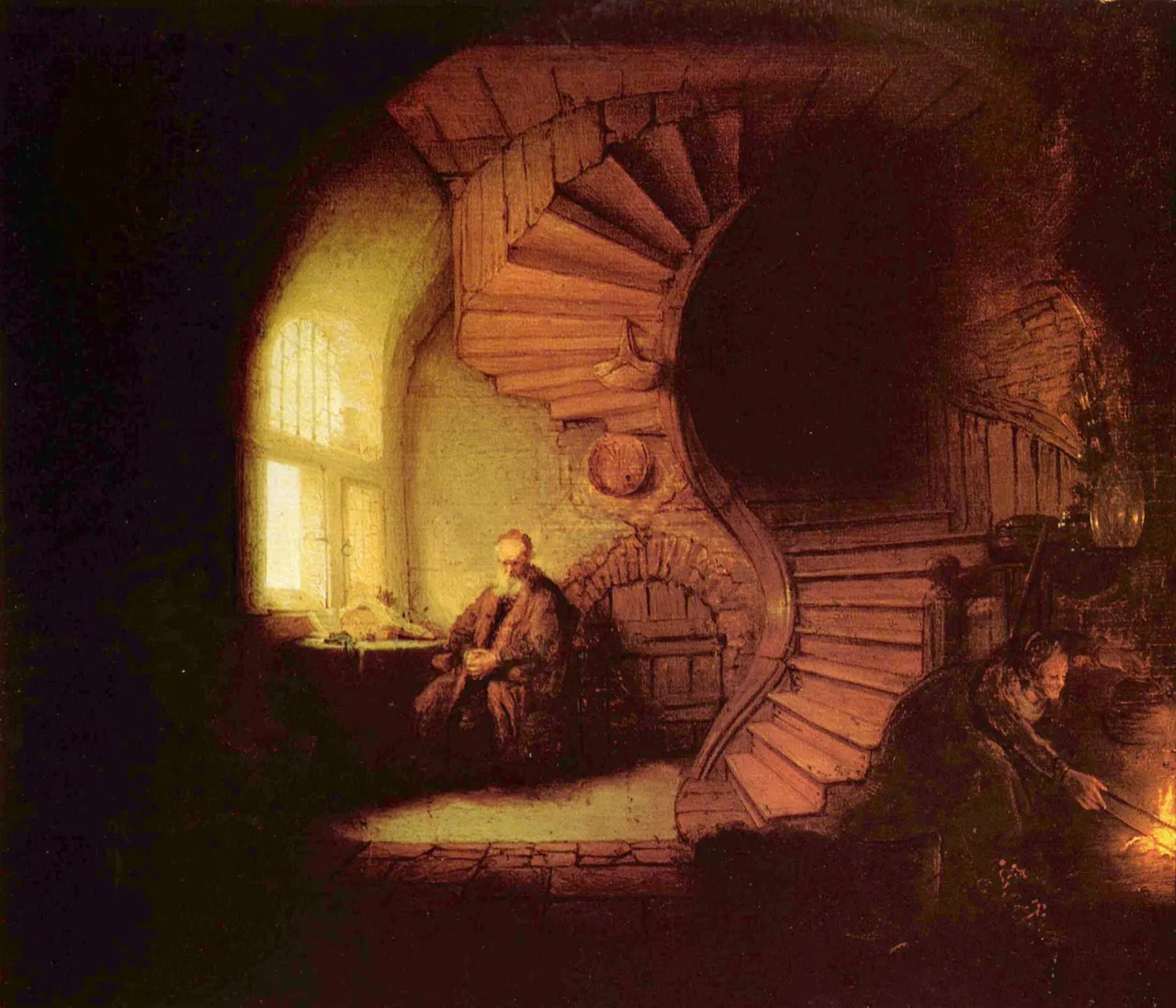
Rembrandt’s old philosopher is a portrait of someone who has spent a lifetime accumulating things in his head. As with the guild master, for a long time the safest vault for knowledge was a person’s mind. Kept there, it was free, and it made that person precious.
The age of agents knocks on the door of that vault. What’s locked in a head doesn’t reach the agent, so now it has to be pulled out and erected as a solid reference. That work clearly has a price, and the resistance to that price is rational. But the debt was always owed, and paying it cleverly shrinks the burden dramatically. Select only what’s needed for action, draw it out automatically as a byproduct of the work, and return the payoff to whoever drew it.
In the end, truth isn’t held up by anyone’s willpower or diligence. It’s held up by the structure beneath it. If what a single source of truth does for an agent is one half, then who holds that truth up, and how, is the other half. Building a good structure is precisely that other half.
— tomte