I wrote this piece with an agent too. The agent gathered the sources, we worked through the spots where the draft stalled, and the English version started from the agent’s translation before I went over it. And yet, if you ask me whose sentences these are — the ones you’re reading now — I answer without hesitation: mine. How I can say that is what this piece is about.
The method itself is simple. I decide what to write and why. I decide the angle, and which sentences live and which get cut. The labor in between — gathering scattered sources, filling the blanks in a draft, carrying it into another language, polishing it so search can find it — goes to the agent. Then I read back what returns, line by line, and fix it. I hold the start and the end, and hand over only the middle.
What got better
Three things changed once I started working this way.
The first is speed. More precisely, less stalling. Writing slows down not because the typing is slow but because you can’t get the first sentence out, or because you snag somewhere in the middle. When I throw a stuck passage at the agent and ask it to take a pass, the draft comes back good or bad, and the wheel that had stopped starts turning again. Ethan Mollick of Wharton calls this unblocking. He has said that almost none of the AI’s sentences made it into his own book. You don’t copy the output; you use it as a foothold to climb out of the stall.
The second, unexpectedly, is that my thinking widened. The agent is a tireless sparring partner. I have it throw objections at my own argument in advance, quickly map an unfamiliar field, point out the counterexamples I’d have missed. Write alone and you tend to circle inside the fence of your own ideas; this is like having something beside you that keeps knocking on that fence. Of course, this only works when I actually weigh the answers that come back. I’ll return to that caveat shortly.
The third is that I can share further. Sending a piece written in Korean out in English used to be a multi-day job on its own. Now I take a first-pass translation and refine it. In 2026 a survey in the journal Learned Publishing asked 105 researchers across 25 language backgrounds, and the uses non-native speakers reached for most were grammar correction (72%), style polishing (63%), and translation (45%). When the language barrier drops, the writing travels farther. But the study attached a caveat of its own: to evaluate the AI’s suggestions, the person still needs enough language ability to judge them.
What wears away when you skip it
That’s the good news. And yet the better someone writes, the more wary they are of this method. The worry gathers in one place: the act of writing is itself the act of thinking, so skip it and the thinking goes too. Three people named the same fear from slightly different angles.
The essayist Paul Graham sees writing and thinking as, flatly, one thing.
“To write well you have to think clearly, and thinking clearly is hard.” — Paul Graham, “Writes and Write-Nots” (2024)
So he predicted the world would soon split into people who can write and people who can’t, and that this split is also a split between people who can think and people who can’t. The moment you set writing down, the very capacity to think withers with it. The Leslie Lamport line he quotes compresses it: if you’re thinking without writing, you only think you’re thinking.
The loss Ted Chiang points to is a different one. He sees writing as the residue of a great many choices.
“Your first draft isn’t an unoriginal idea expressed clearly; it’s an original idea expressed poorly.” — Ted Chiang, “Why A.I. Isn’t Going to Make Art” (2024)
Fumbling through that poorness is the act of thinking, and if you skip it with a tool that smooths everything to an average, the originality goes with it.
The author Cory Doctorow touches something more fundamental. He called such tools plausible sentence generators. A sentence that sounds plausible and a sentence that is correct are not the same thing, and while the tool makes producing sentences easy, telling whether they are right gets no easier at all. That asymmetry between production and verification is the heart of the problem.
The fork is supervision
The worry is right. With one condition attached.
That skipping the act of writing wastes thinking is true, precisely, when you skip the verification too. The fork comes down to one thing: is there supervision, or isn’t there? Doctorow himself sharpened that fork best, in the same essay.
“if we don’t understand a subject, then we won’t be qualified to evaluate the summary, either.” — Cory Doctorow
Flip that sentence and it becomes the rule I work by. I can only write what I understand. Beyond that, however plausible the sentences the agent brings back, I can’t tell right from wrong, and I can’t put my name on writing I can’t tell. Which resolves the caveat I set aside earlier: the agent widens my thinking only when I weigh the answers that come back. An answer I can’t weigh isn’t a widening — it’s a plausible cover over a blank.
So the answer to “who is the author” is not who typed. It’s who takes responsibility, in the end, for this is right. The reason US and European copyright law anchors protection in meaningful human contribution rests on the same intuition. Not the fingers but the judgment makes the author.
The line between dictation and collaboration runs through exactly here. Dictation skips the verification; collaboration keeps the verification in my hands to the end. Take down what’s whispered, word for word, and it’s the whisperer’s writing. Listen to the whisper but weigh each line and write it yourself, and it’s yours.
I hold the pen
I wrote before that understanding can’t be outsourced. The execution of thinking can be handed off and a result still comes back, but the understanding that holds the work up goes hollow the moment you hand it over. Writing is where that principle shows itself most honestly. However fast the tool carries the surface, the final call — asking whether this is right and sending it out under my name — does not cross over. As long as I write that one line, this piece is mine.
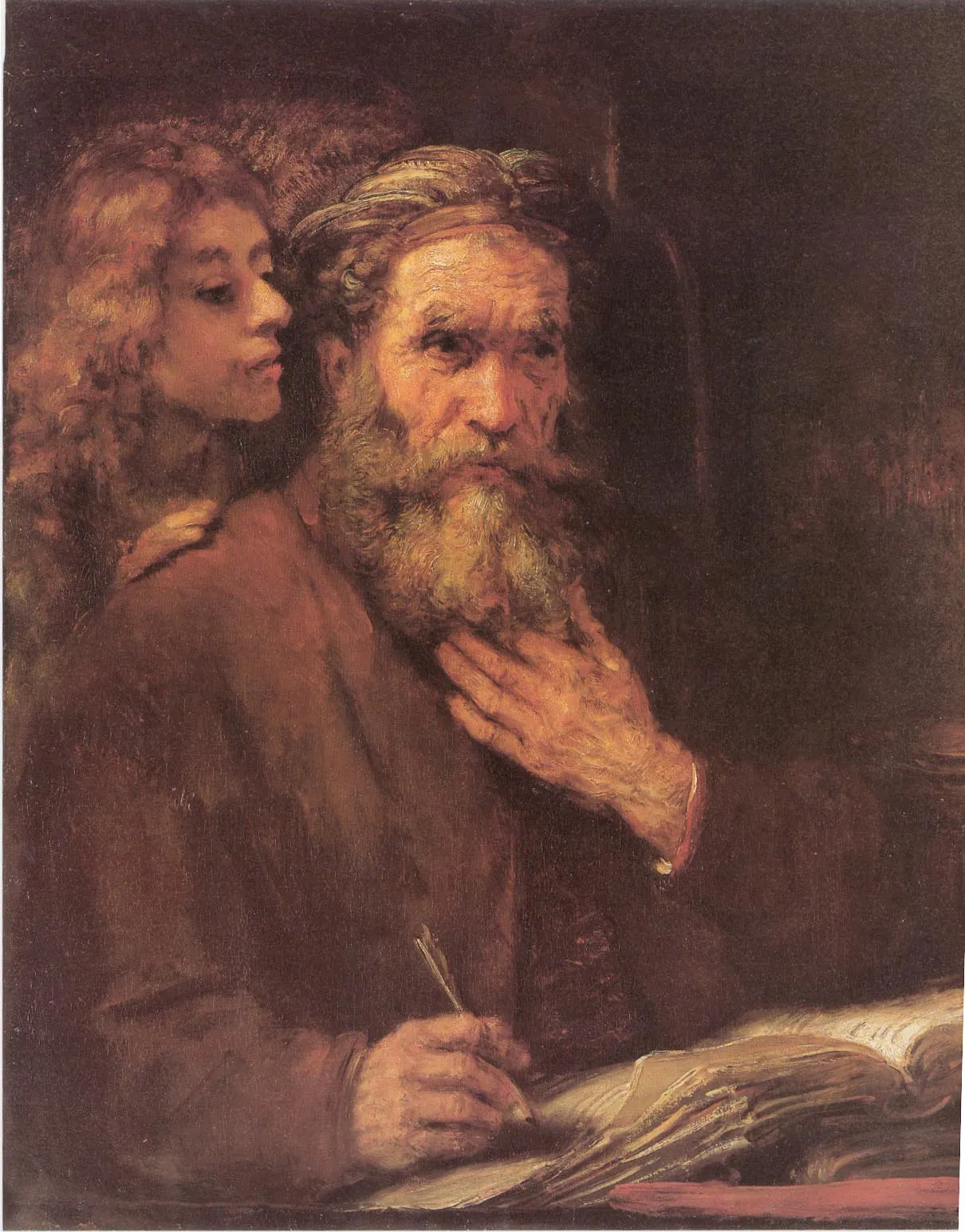
I look again at the Rembrandt above. The aged evangelist Matthew sits before his book, and an angel leans in from behind to breathe something into his ear. But the hand gripping the pen, drawing the letters onto the page, is Matthew’s. So is the deciding — what to take in, what to let pass, what in the end to set down.
The angel whispers beside me. The pen, I still hold myself.
— tomte