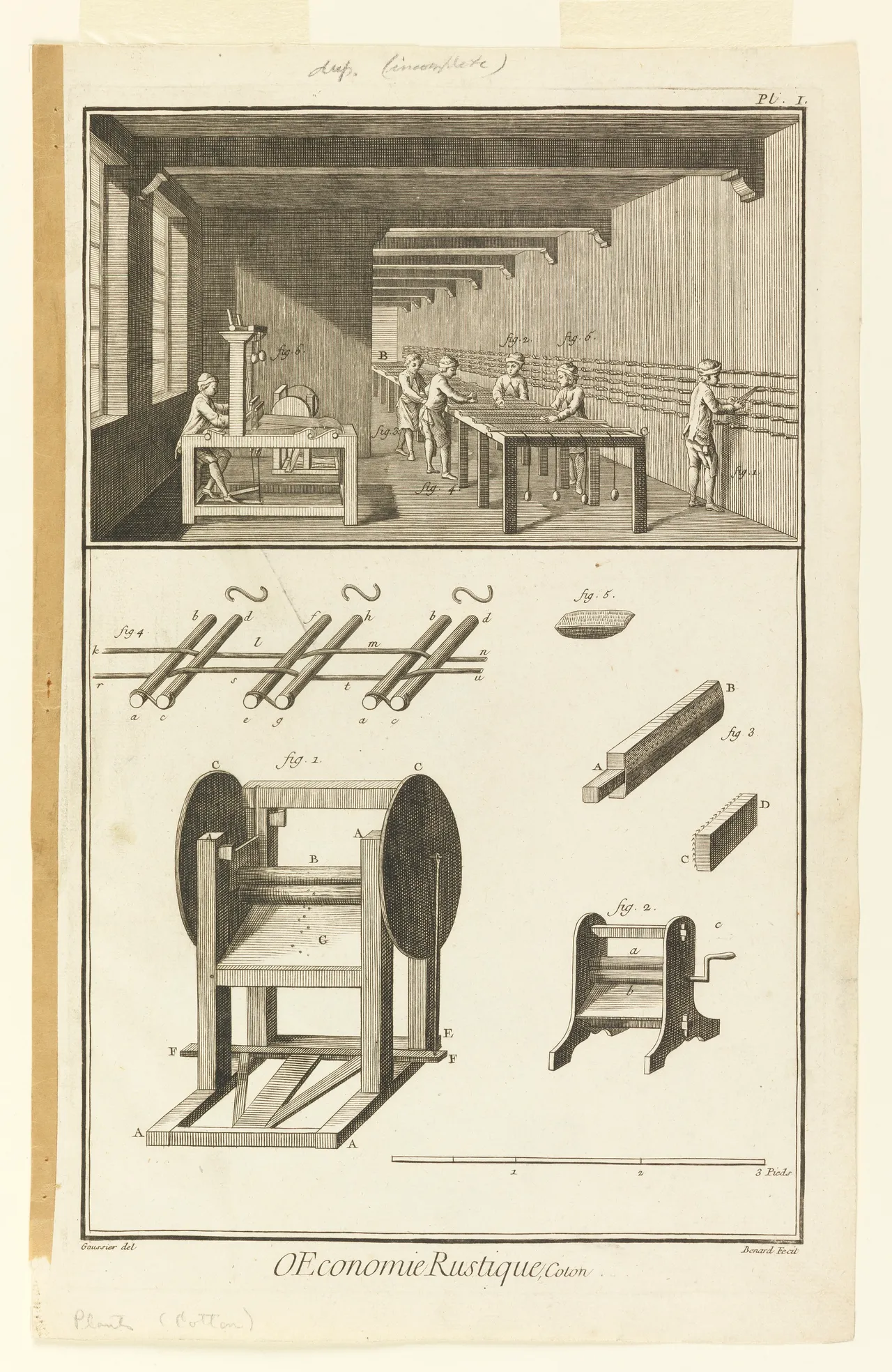
Some 250 years ago, Denis Diderot and Jean le Rond d’Alembert set out to do something reckless: put every craft and technology in the world into a single work. The result was the Encyclopédie. It held more than philosophy and science. Alongside the text ran thousands of engraved plates that took apart the blacksmith’s hammer and the gears of the loom and drew each piece. The upper panel shows a workshop, people gripping their tools and working; the lower panel lays out those same tools disassembled, part by part. For Diderot, to understand a human being was to understand what humans make and what they make it with. A tool was not some accessory bolted onto the human mind from outside. It was the very way the mind met the world.
To talk about the software called Notion, it’s better to begin here. To most people Notion is “a kind of pretty all-in-one app — notes, wiki, to-do list, all in one.” That isn’t wrong, but it isn’t what the founder set out to build. He wasn’t after another convenient app. He was after something closer to what Diderot was doing with those plates: changing the very tool a person uses to handle their own thinking. Let’s follow where that ambition came from, and how it ended up carrying a contradiction.
The tools that shape us
The starting point is the media theorist Marshall McLuhan. In the 1960s he pointed out that we usually have it backwards. People pay attention to what content a medium carries, but what changes a person more deeply is the medium itself. The same piece of news read in a book and watched on television leaves us thinking in different ways. As the dish changes the taste of the food, the medium changes the shape of thought. That is what the famous line “the medium is the message” means.
One sentence pushed this a step further and became Notion’s spiritual point of departure. McLuhan’s colleague John Culkin distilled the idea into a single line.
Change the tool in your hand and the kind of thinking you can do changes with it. A person writing on paper and a person writing in a spreadsheet see the same problem differently. Which means that “building a better tool” becomes, directly, building a person who thinks better. That equation — to shape a tool is to shape thought — sits at the bottom of how Notion understands its own work. It means seeing software not as a bundle of features but as a medium for thinking.
A forgotten promise
McLuhan laid down the premise. The people who first applied that premise to the computer were others entirely — two figures Notion claims as its own lineage.
Douglas Engelbart. He’s usually remembered as “the man who invented the computer mouse,” but that’s a footnote. His real life’s work was augmenting human intellect. In the 1960s, when the computer was seen as a giant calculator that filled an entire room, he argued it should be treated as a medium that helps people think their way through complex problems. In a 1968 demonstration he presented, all in one sitting, the mouse, hyperlinks, real-time collaborative editing, video conferencing, and the windowed interface. Nearly every prototype of the computer screen we use today was packed into that single demo. Notion’s founder would later call Engelbart the company’s “patron saint.”
Alan Kay. He tried to carry Engelbart’s vision into the hands of everyone — children most of all. In 1972 he conceived the Dynabook, a personal portable computer a child could carry, learn on, and build with. He had sketched the laptop and the tablet forty years early. Smalltalk, the programming environment he created, became the root of today’s graphical interfaces and object-oriented programming. Kay’s worldview, in a sentence: a computer should not be a machine for consuming fixed functions but a malleable material from which the user shapes their own tools.
The line connecting the three is clear. The premise that tools shape thought (McLuhan), therefore the goal of using computers to augment that thought (Engelbart), therefore the method of making software out of soft Lego rather than hard plastic (Kay). What they shared was a common regret: that the industry betrayed this promise. Most of the software we use every day became a “finished product” that performs only the fixed motions allowed inside the boxes a company drew for it. The computer hardened from a medium of creation into a terminal for consumption. This is where Notion’s story begins — by appointing itself the heir to the promise Silicon Valley forgot.
Notion’s answer: a tool for making tools
So Notion didn’t enter the race to build a better dedicated notes app, a better dedicated wiki, a better dedicated database. Instead, founder Ivan Zhao and co-founder Simon Last set out to hand people basic units, like Lego bricks: a line of text, an image, a table, a callout box, an embed that pulls in outside material. Users assemble these units themselves and, from them, build the tool that fits their own problem.
The heart of it is a single principle, simple but powerful. Everything is a block, a block can be any type, and blocks nest inside one another. A heading is a block, a table is a block, a row inside the table is a block, even a page is a block. And a block can hold other blocks. A database goes inside a page, and that page goes inside a list.
Zhao framed the meaning of this design this way: if everything is a block and blocks can nest, then what you’ve made is not a feature but a language. Rather than implementing features one at a time, you build a primitive that anything can be assembled from. The features fall out of the combinations on their own. It’s how the Lego company sells not a “house toy” and a “car toy” but the same bricks. Whether you build a house or a spaceship is up to whoever holds the bricks.
This is exactly what “a tool for making tools” means. Notion doesn’t sell a finished tool; it sells the material you build tools from. This is where the ideal that ran from McLuhan to Kay got translated into the form of a product.
Rewritten in Kyoto
The ideal didn’t become a product overnight. Notion died once — almost completely.
In 2013, Zhao and Last founded the company and raised angel money. The vision was “software Lego” from the start. But the first version was all ambition. Built on an experimental, unproven Google web technology of the time, the product kept crashing, and it wouldn’t scale. The deeper wound was elsewhere. The first Notion openly billed itself as “an app for anyone to build software without code” — and people didn’t want that. The desire to build their own tools simply wasn’t there in the wider public.
By 2015 the funding was gone and the company was on the edge of bankruptcy. The two of them let their small team go and moved, just the pair of them, to Kyoto, Japan. In a tiny apartment where a single sliding screen divided the bedroom, neither washing nor cooking, they rewrote Notion from scratch, eighteen hours a day. Out of the noise of Silicon Valley, with their cost of living cut to the bone, they tore out the unstable foundation and laid down the block engine Notion runs on today.
More important than the technology was the realization that came in this stretch. To become big software, you have to start from something familiar — something everyone already knows — and hide the power to make tools. Zhao put it as “sugarcoating the broccoli.” Bury the nutritious part (the programmability) inside, and serve the outside as a pretty document app anyone can pick up at once.
The rewritten Notion 1.0 launched in 2016 to a warm reception and climbed back up by word of mouth. The difference between dying and surviving came in three layers. They laid their own engine instead of borrowing someone else’s half-built tech; they hid the fact that it was a tool instead of advertising it; and they built a language — “everything is a block” — instead of implementing features one by one. The vision went untouched. What changed was only how they built it right and put it in people’s hands.
The shadow of a grand pedigree
That is the story Notion tells about itself. But the grander the intellectual pedigree you claim, the wider the gap with reality grows — and Notion has been shadowed all along by criticism aimed straight at that gap.
First, the charge that it’s a jack of all trades and master of none. Notion is serviceable across documents, wikis, and project management, but its notes never beat a dedicated notes app and its tables never beat a dedicated database tool. The price of being universal is coming in second everywhere.
Second, a sharper criticism: that “a tool for making tools” is closer to marketing than fact. The ideal says users make their own tools, but what users actually do is closer to picking and arranging from a menu of blocks Notion has decided in advance. The real lineage of “tools for making tools” — the spreadsheet, the programming language — handed users genuine logic and automation. Notion is weak right there. Complex conditional branching and automation hit clear limits, and for most users Notion stops at making and viewing content.
Third, the most paradoxical part. The lesson Zhao drew from the first failure was “people don’t want to make tools, so hide it.” But this very success strategy becomes the grounds for the criticism — because it means that, to most people, Notion is just a pretty document app. Only a handful of power users actually exercise the “tool for making tools” ideal; for everyone else it’s consumed as precisely a content tool. The fact that hiding it is what made it succeed is itself the strongest evidence for the question, isn’t this just a content tool?
There’s a reason these criticisms cut so deep. Notion set the high bar of Engelbart and Kay itself, as its own measuring stick. An ordinary productivity app would have heard “it’s slow” or “the tables are weak.” But a company that promised “the augmentation of human intellect” gets measured by a different ruler.
The ideal of the tool goes on trial
The idea that runs from McLuhan through Kay to Notion — that tools shape human thought, so give people the material to shape their own tools — is seductive. But as seductive as it is, that’s how far it stands from the reality of closed subscription software. Notion’s story is the story of that ideal and that reality pushing and pulling at each other.
And lately this tension has gone on trial in an entirely new way. As AI agents — AI that carries out work on a person’s behalf — begin to read and write documents directly, the very premise that a person shapes their own tools starts to wobble. If the one handling the tool is no longer a person but an agent, are Notion’s blocks an asset or a shackle? How should the proposition that tools shape people be rewritten for the age of the agent? That story continues in the next post.
The idea that you can hand a tool the execution of thinking but not the understanding is in You Can Outsource Thinking, But Not Understanding; the way tools reshape the form of an organization is in The Taxonomy and Evolution of Org Structures.