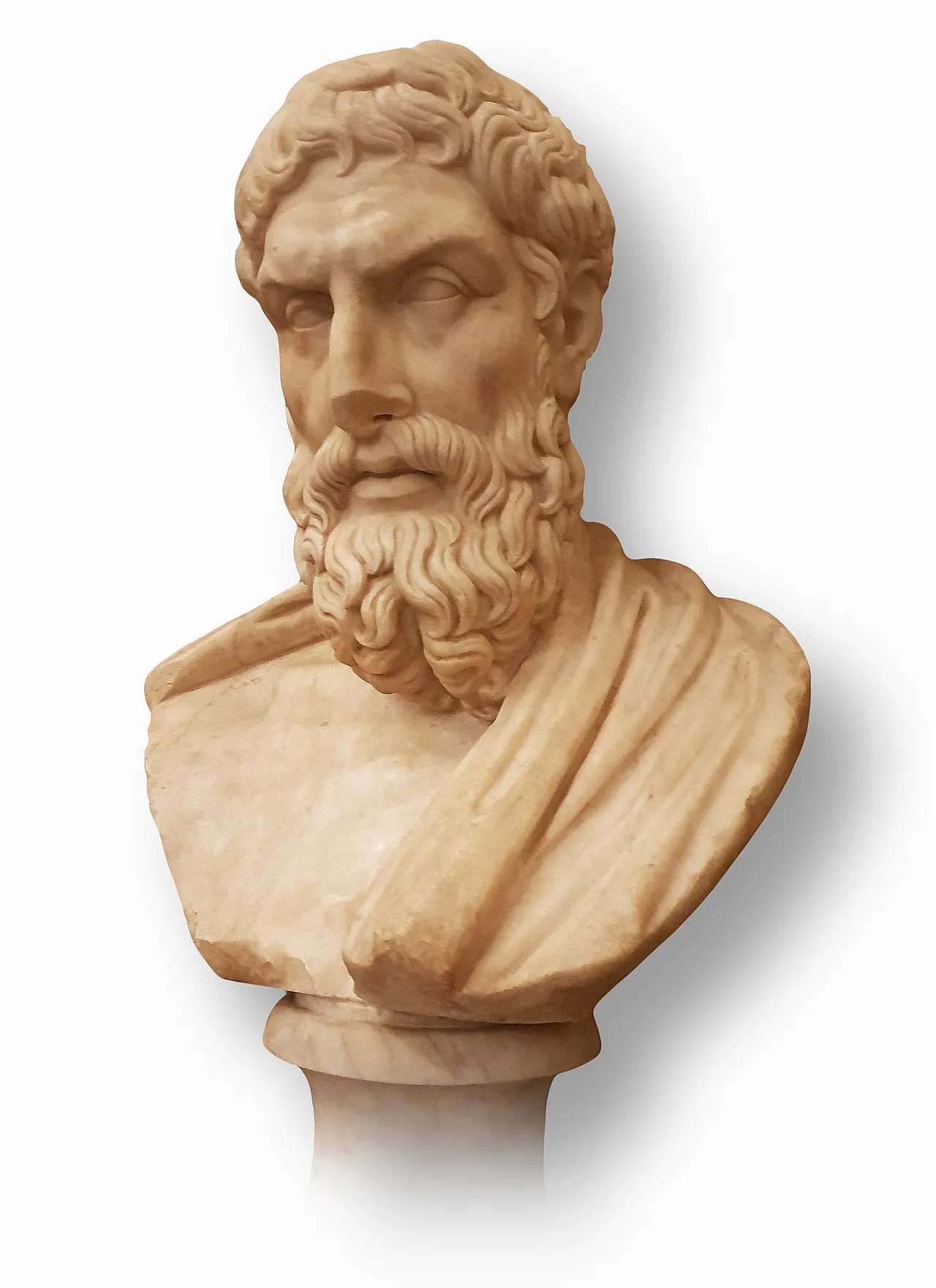
Epicurus usually gets filed under “hedonist.” The label is stubborn enough that Epicurean hardened into a word for a gourmet or a pleasure-seeker. And yet the life he actually recommended wasn’t feasts and indulgence but bread, water, and a few friends. This is the man who wrote that with a bit of cheese on hand, he’d dine in style. The pleasure he aimed at wasn’t a heap of stimulation but a state of mind that doesn’t waver — ataraxia in Greek, tranquility.
Trace where that calm comes from and his philosophy turns out to be surprisingly clean and practical. And it’s precisely that cleanness that leaves it structurally weak in front of everything calm is not: adventure, passion, the leap. Let’s work out what the calm actually is first, then push to the point where it cracks.
Calm comes not from gaining more but from fearing less
His starting point is a little unexpected. As he saw it, we’re unhappy not because we lack desires but because we’re harassed by fears and empty cravings. So the prescription isn’t addition — it’s subtraction. Calm isn’t something you reach by filling up. Clear away what’s stirring the mind and calm is what’s left.
Later generations boiled his prescription down to four lines: the tetrapharmakos, literally “four-part cure.” It treats, one by one, the four things that weigh the mind down.
First, the fear of the gods. The gods are perfectly happy beings, so they’ve no reason to meddle in human affairs. Thunder isn’t somebody’s wrath; it’s just atoms in motion. The pains Epicurus took over atomic physics weren’t an academic hobby but a tool of calm. Only once you know the world runs on law and not on a temperamental god can you be freed from the superstitious dread that reads lightning and disaster as divine punishment.
Second, the fear of death. His most famous argument. “Death is nothing to us. While I exist, death is not; when death comes, I am no longer.” To dread in advance a thing we can never even undergo is fear aimed at the wrong address from the start.
Third, the fear of pain. Sharp pain is usually brief, and pain that lasts tends to stay bearable. Intensity and duration tend to run opposite, so it isn’t as terrifying as vague dread makes it out to be — a comfort you arrive at by actually taking the measure of it.
Fourth, the fear of not getting what’s good. The things you actually need to live are, in fact, easy to come by. This fourth point opens onto his redefinition of pleasure.
One logic runs through all four. Pin down exactly what a fear is and the fear comes loose. (The third, the cure for pain, runs a little differently — there the problem isn’t ignorance of what it is but the vague swelling of it, so the move is to gauge its real size and let the air out.) It’s almost a prototype of modern cognitive therapy. Calm isn’t squeezed out by willpower; it follows as a by-product once a false belief is set straight.
Pleasure isn’t filling up — it’s emptying out
This is where he gets misread most. For Epicurus, pleasure isn’t intense stimulation but two kinds of absence: no pain in the body (aponia), no disturbance in the mind (ataraxia). The state of a lack being met and balance restored is, in itself, the highest pleasure.
Picture a glass of water when you’re thirsty. That first glass is intensely sweet. But once the thirst is gone, pouring more in doesn’t make the pleasure greater — it just leaves you bloated. So “not being thirsty” is already the peak, and chasing some fancier drink from there is wasted effort that breaks the calm.
By this measure he split desires into three. Natural and necessary ones — food, shelter, safety, friendship — fill them; it’s easy. Natural but unnecessary ones — lavish meals, a grand house — enjoy them if they come, but don’t cling. And empty, hollow ones — fame, power, endless wealth — be wary of these. They have no ceiling, so they’re never satisfied, and so they break the calm forever.
The two pillars that hold the calm up: friendship and obscurity
Calm isn’t kept by inner work alone. Epicurus stressed two outer conditions.
One is friendship. “Of all the things wisdom provides for a happy life, the greatest by far is friendship,” he said. He actually founded a community in Athens called the Garden (Kēpos), an experiment in living simply with friends — and, radically for the time, he admitted women and slaves as equal members.
The other is obscurity. Lathe biōsas — “live unnoticed.” He saw stepping out of the contest for politics and fame as a condition of calm. The moment you climb onto the competitive track, your inner balance is held hostage by others’ judgments and by winning and losing.
That’s the prescription, in full. Dismantle your fears, cap your desires, live quietly inside friendship. It really is a way to make the mind lighter. But the prescription leaves one thing out.
The thing is, this calm is a ‘defensive happiness’
Look closely at the happiness Epicurus describes and it’s all built from subtraction. A state with no pain, no disturbance, no fear, fewer desires. Every one of them is a freedom from something, never a freedom toward something.
This is the happiness of a ship anchored in harbor. No waves, no risk of sinking. Safe. But a ship is, by design, made to go out to sea. Epicurus says the best thing is to never be shipwrecked, and someone could ask back: what kind of ship is a ship lashed to the dock?
The trouble is that a great deal of what humans want presupposes disturbance. To want something fiercely is to sign a contract that you’ll suffer in its absence. Love, ambition, the urge to create — each comes braided with the anxiety of what if I don’t get there. Adventure goes one further: it’s the act of deliberately exposing yourself to the possibility of pain. The person climbing a mountain doesn’t climb for the absence of pain but for the sheer intensity of the strain and the summiting itself. By the yardstick of ataraxia, all of this is risk that breaks the balance.
Why Nietzsche turned away
The one who jabbed at this weak spot most sharply was Nietzsche. He once admired Epicurus deeply, then turned away as his own philosophy ripened. As Nietzsche saw it, Epicurus’s calm was less a stillness reached from overflowing strength than a state that has sunk down from exhaustion. A happiness like this, he needled, is one only a person who has suffered constantly could even conceive. Isn’t this really just someone with no strength left to desire great things, talking himself into the wisdom of not desiring at all?
For Nietzsche, what really moves a human being isn’t calm but the force that hauls you up and drives you past your own limits. And Epicurus sorts exactly that drive into “empty desire” and weeds it out. In exchange for calm, you hand back the very possibility of living intensely. So a thoroughgoing Epicurean has a hard time falling deeply in love, founding a company with everything on the line, or throwing himself into changing the world. Each of those is a bet that puts the calm up as collateral.
And yet what he blocked was ‘blind’ passion
Still, to cast Epicurus simply as the enemy of passion is to read him too narrowly. His philosophy has another axis: phronesis. It’s usually rendered as practical wisdom or prudence; unpacked, it’s the ability to reckon ahead. Don’t take the pleasure or pain in front of you on its own terms — count what it’ll drag along later, and choose on that basis.
So his arithmetic is less simple than it looks. Some pain comes back as greater pleasure, so endure it gladly; some pleasure pulls greater pain behind it, so refuse it. Swallow the bitter medicine, keep away from the sweet poison. The grind of exercise, the discomfort of restraint, the sting of facing an uncomfortable truth — these were pains he actually recommended. The thrill of drinking too much, the satisfaction of luxury — these he warned against, for the hangover and the emptiness that follow. So he didn’t say avoid pain at all costs; he said take on the pain that’s worth what it costs.
Hold up that yardstick and the real target of his caution comes into focus. He was wary not of passion as such but of blind passion — more precisely, of the desire that has no end and so only ever feeds its own thirst. Fame, power, boundless wealth were like that. However much you pour in, “just a little more” tags along, so stake your heart on it and you’ll never reach calm in a lifetime. A challenge with a clear end, an adventure you enter knowing the price — these can be justified within his arithmetic just fine. What he blocked was the bottomless jar, not the bowl whose floor you can see.
And he himself wasn’t some man hiding out in apathy. He founded a school, wrote voluminously, raised disciples. Building the Garden as a community was an active project staked on a lifetime. So his obscurity reads less as a flight into doing nothing than as a choice about where to spend his strength. He pulled his feet out of the vast game he couldn’t control — politics, fame, the crowd’s verdict — and poured everything into the small yard he could tend himself.
Even so, one thing finally remains. That same phronesis — the posture of always weighing the gain and moving only when something’s left over — is a different animal from the kind of passion that stops weighing and just throws itself in. In the moment you fall hard for someone, or stake a life on something that looks reckless, there’s no room for the ledger of profit and loss to butt in. Epicurus was a man who never once let go of that ledger. The same strength that protected him is also the place he never reached.
So the question that’s left: calm or fullness
In the end this philosophy stands us at a fork. Is the good life a calm life or a full one? The two often point in different directions.
At one end stand Epicurus and the Stoics — another ancient school that aimed at the same calm by way of detachment from the world’s affairs. Their methods are exact opposites. Epicurus by withdrawing from the world; the Stoics by plunging into the thick of it while growing indifferent to what they can’t control. Same goal: not wavering. At the other end stand Nietzsche and the Romantics. For them the measure of life isn’t calm but intensity. How fiercely did you live?
Epicurus’s calm looks shaky in front of passion not because his philosophy is wrong but because it’s measuring something else from the start. He only teaches how to lower the total volume of wavering; he doesn’t teach how to deepen it. So before you take his prescription, there’s one thing to ask yourself. Do I want not to waver — or do I want, just once, to be properly shaken?
His prescription for dissolving fear works on nearly anyone. How far you’ll take the medicine, though, splits person to person. Some want to drop anchor in still water; some, knowing they’ll be battered, can’t rest until they’ve made for open sea. Epicurus is a guide for the first kind. If you’re the second, take only half his medicine.
— tomte
Read next · Schopenhauer’s Will and Boredom, Epicurus’s Calm: How to Tame Desire · Dopamine Isn’t the Pleasure Chemical: Wanting and Liking · Csikszentmihalyi’s Flow