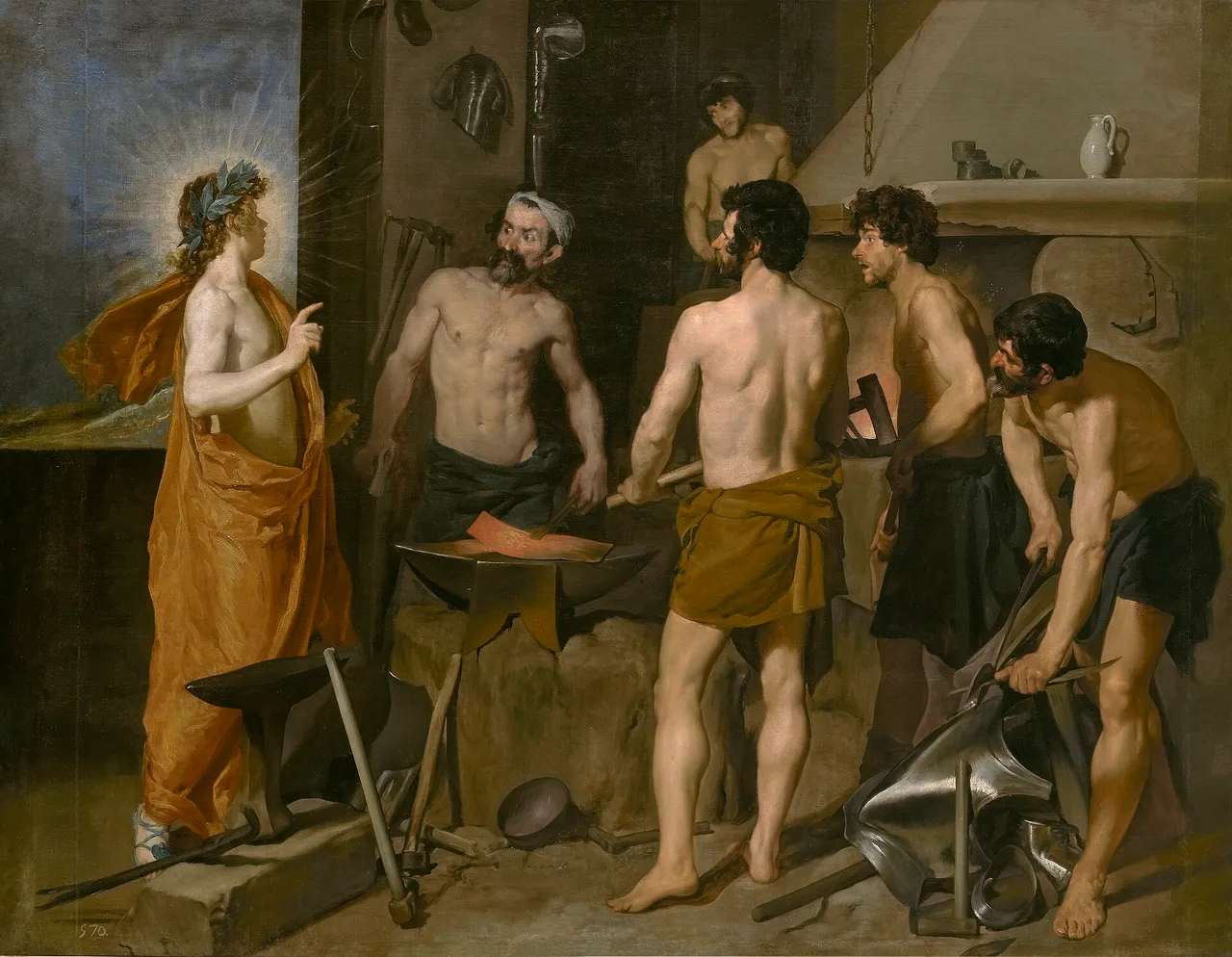
Some people lose track of time when they’re making something, and come out of it strangely full. It doesn’t matter whether the thing is code, a piece of furniture, an essay, or a loaf of bread. We tend to file this under craftsmanship, or taste, or just personal temperament. But the pull toward making runs far deeper than a hobby. It’s an instinct that 2.5 million years carved into our species.
Ask why people love to make things and the answer comes in layers, not one. A reward circuit evolution wired in; the psychological pleasure of feeling your will land on the world; and the existential urge of a mortal creature pushing back against time. Three layers stacked on each other. Let’s go down one at a time.
Tools made the brain
Among the names we’ve given ourselves is Homo faber, “the maker,” a counterpart to Homo sapiens, “the knower.” The philosopher Henri Bergson used it to locate the essence of intelligence not in knowing but in the capacity to make tools; earlier still, Benjamin Franklin defined the human as “a tool-making animal.” The idea is that making, not knowing, might be the deeper definition of what we are.
This isn’t wordplay. There’s research arguing that the act of making tools is what grew our brains. Around 2.5 million years ago our ancestors began striking stone precisely to set an edge. To break a stone properly you have to plan the angle and force, remember the sequence of moves, and control your hands by tiny degrees. What’s striking is that the brain region governing this fine hand control overlaps substantially with the region that would later handle language. So researchers suspect that toolmaking, brain growth, and language evolved as a single bundle. The ones who made better survived better, and that disposition got carved into us.
Seen from this layer, loving to make is no different from loving sweetness. The brain attached a reward — pleasure — to behavior that helped us survive. Just as sweetness once signaled “rich in calories,” the joy of making once signaled “make tools; they keep you alive.”
What sits here isn’t a single arrow that fires once but a feedback loop. Hands shaped stone, and that hand-work grew the brain; the bigger brain made finer tools; those tools changed the brain and society again. At first we were the ones making the tools, but at some point the tools became the ones shaping us. Handling fire shrank our gut and our jaw; inventing writing changed how we remember. Making isn’t a side ability of being human — it’s the engine that keeps rewriting our species.
The feeling of your will landing on the world
If evolution is the wide shot, the level of everyday motivation holds a smaller, more immediate reward. The psychologist Robert White called it effectance motivation. Humans take pleasure not in reaching some particular result, but in the bare confirmation that they can have an effect on their environment.
Picture a baby shaking a rattle. No nutrition, no purpose. But “I shake it and it makes a sound” — the feedback that the world answers to my will — feels so good that the baby repeats the motion without end. Making is the grown-up version of that feeling. You take material that won’t bend to you on its own and press your intention into it until it holds a shape. Effectance motivation is the purest form of a sense of control and self-efficacy, and making fills that motivation more directly than anything else.
There’s one more advantage that only making offers: immediate, unambiguous feedback. Whether the cut came out clean, whether the dough rose — you see it at once. This instant feedback and clear goal happen to be core conditions for flow to take hold. There’s a reason making is the kind of activity that erases your sense of time and pulls you under.
You love what you made
The reward of making doesn’t end while you’re making. It carries on after the thing is done. Behavioral economics has a name for it: the IKEA effect. People feel far more attachment to an object they built themselves than its objective value warrants. In experiments by Michael Norton and colleagues, people put higher prices on furniture they assembled or paper boxes they folded than they’d pay for a finished product — and they did it even when their crooked handiwork came out worse.
The reason is simple. What I made holds my labor and my time, which is to say a part of myself. It isn’t a mere object but a mark of me pressed onto the world. That we can’t easily throw away the things we made ourselves isn’t irrational clinging — it’s an accurate read that a part of us is lodged in there.
How a mortal creature resists time
The deepest layer is existential. The human is almost the only animal that knows it will die. So the urge runs deep to make “something that stays after I’m gone.”
The political philosopher Hannah Arendt set this urge as one axis of human activity in The Human Condition. What she called Homo faber has a slightly different grain than Bergson’s — the working human, the one who builds things that outlast their maker. This human doesn’t labor for what’s used once and gone. They build what survives them: desks, houses, tools, works. The artifacts that pile up this way form the stable stage we call “the world,” and the next generation lives out its life upon it. Making, then, is how a finite being leaves a mark on the passage of time.
From this view, an essay, a line of code, a house are all writing the same sentence: I was here. The reason making delivers such deep satisfaction is that it’s the most concrete way a creature that knows death pushes back against time.
So why do some people hate making?
Here a natural objection arises. If making is really an instinct, shouldn’t everyone love it? And yet there are clearly people who wave it off entirely.
The fork usually opens at one spot: what the process of making grew up tangled with. For someone whose joy in making got wound together with evaluation, with scolding over failure, with nagging that hounds the result, that circuit gets pressed flat. Not because the instinct isn’t there, but because fear was painted over the instinct. The pressure to “make it good” overwrote the signal that “making is fun.” So saying you hate making is, more precisely, close to saying you hate the evaluation that surrounds making.
Flip it and you get this: someone who still enjoys making is someone whose circuit was never pressed flat. It means the process and the fear stayed separate — and that’s closer to luck than to talent.
A temperament to feed well
So this disposition isn’t something to fix. It’s a temperament to feed well. Good material, time to work your hands, focus that goes uninterrupted. For the person who makes, these aren’t luxuries but nutrition.
On the reward circuit evolution planted, the pleasure of your will landing on the world and the urge to resist time stack layer on layer to form the drive to make. So the pull you feel when you make something isn’t a minor taste. It’s the very force that has made humans human, turning once more at your fingertips 2.5 million years on. If you feel most alive when you make, that means you’re close to the most human moment there is.
— tomte
Read next · Csikszentmihalyi on Flow · Dopamine Isn’t the Pleasure Chemical · You Can Outsource Thinking, But Not Understanding